Quick Answer
Neither SEO nor paid ads is “better” on its own, they solve different problems. SEO builds free, compounding organic traffic but takes 3–6 months to show results. Paid ads deliver traffic within hours but stop the moment you stop paying. Small businesses that need leads now should start with paid ads; businesses building a long-term brand should invest in SEO; most growing companies eventually need both. Below, we break down the cost, speed, and ROI of each, and how to decide which one your business needs first.
Introduction
If you’ve typed “SEO vs paid ads” into Google, you’re probably staring at a marketing budget and wondering where the next dollar should go. It’s one of the most common questions business owners ask, and it’s also one of the most misunderstood, because the honest answer isn’t “pick one.” It’s “understand what each one is built to do, then match it to your timeline and budget.”
This guide breaks down exactly how SEO and paid advertising (PPC) differ in cost, speed, control, and long-term value, so you can make a decision based on your business goals , not guesswork. We’ll also show you when combining both strategies makes sense, and what that looks like in practice.
What Is SEO?
Search Engine Optimization (SEO) is the process of improving your website so it ranks higher in unpaid, organic search results on Google, Bing, and increasingly, AI-powered search tools like ChatGPT and Google AI Overviews. SEO touches everything from website structure and page speed to keyword-optimized content, backlinks, and technical health.
Unlike paid ads, you don’t pay Google per click for organic rankings. Instead, you invest time and resources into making your site genuinely more useful, relevant, and authoritative — and search engines reward that with visibility.
Key Characteristics of SEO
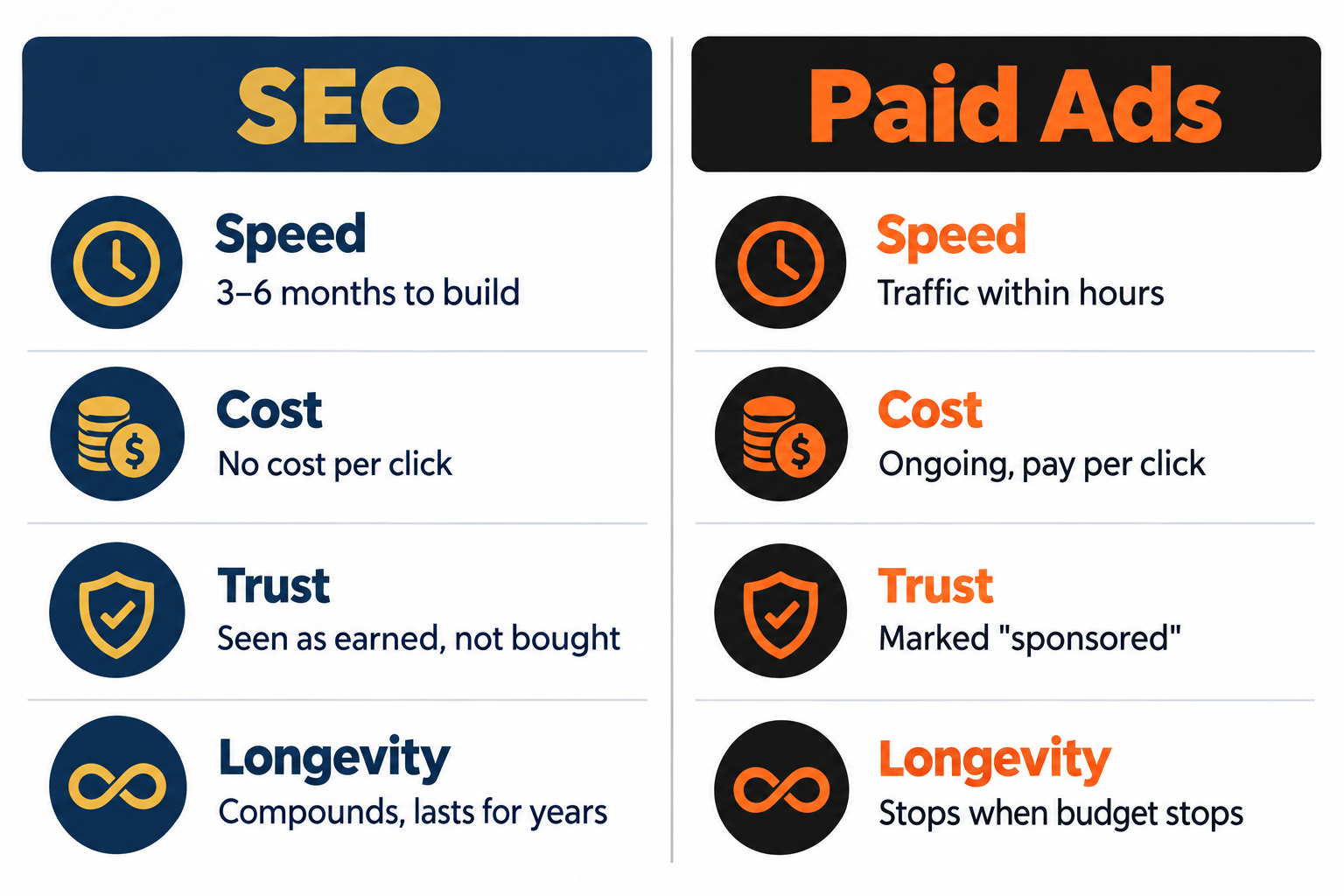
- Speed: Slow to start. Most sites see meaningful ranking movement in 3–6 months, with compounding gains over 12+ months.
- Cost structure: Upfront investment in content, technical fixes, and links; no per-click fees once you rank.
- Trust factor: Studies on search behavior consistently show users click organic results more often than ads, because organic rankings feel earned rather than bought.
- Longevity: Rankings can persist for months or years with minimal upkeep, unlike ads that vanish the moment budget stops.
- Best suited for: Businesses building long-term brand authority, evergreen content libraries, and a steady, compounding stream of traffic.
What Is Paid Advertising (PPC)?
Pay-Per-Click (PPC) advertising, including Google Ads, Bing Ads, and paid social, means you pay a platform every time someone clicks your ad. You bid on keywords or audiences, and your ad appears above or alongside organic results, typically marked “Sponsored.”
Key Characteristics of Paid Ads
- Speed: Immediate. Campaigns can start driving qualified traffic within hours of launch.
- Cost structure: Ongoing and click-based. Traffic stops the moment the budget does, there’s no “banked” equity.
- Targeting control: Highly precise. You can target by location, device, demographic, income bracket, search intent, and even time of day.
- Longevity: Zero residual value once campaigns pause, this is the single biggest trade-off versus SEO.
- Best suited for: Product launches, seasonal promotions, testing new markets , and generating leads on a deadline.
SEO vs Paid Ads: Head-to-Head Comparison
| Factor | SEO | Paid Ads (PPC) |
|---|---|---|
| Time to results | 3–6 months (often longer for competitive industries) | Hours to days |
| Cost model | Upfront/ongoing investment, no per-click fee | Pay per click, budget-dependent |
| Traffic after you stop | Continues (with some decline over time) | Stops immediately |
| User trust | Higher, seen as “earned” | Lower, clearly marked as an ad |
| Targeting precision | Broad, keyword/intent-based | Highly granular (location, demo, device) |
| Scalability | Limited by content/authority growth rate | Instantly scalable with budget |
| Best for | Long-term brand equity, evergreen traffic | Fast leads, testing, promotions |
| Risk if paused | Low, rankings degrade gradually | High, traffic stops same day |
Timeline Comparison: How Fast Will You See Results?
One of the biggest deciding factors in the SEO vs PPC debate is simply: how much time do you have?
- Week 1: Paid ads can already be generating clicks and leads. SEO work (audits, content, technical fixes) is just getting underway, no visible ranking movement yet.
- Month 1–3: Paid ads continue producing steady, budget-dependent traffic. SEO content begins to get indexed and may start ranking for low-competition, long-tail keywords.
- Month 3–6: SEO traffic starts climbing meaningfully for target keywords. Paid ad performance is optimized based on data, but costs remain constant or rise with competition.
- Month 6–12+: SEO traffic often begins outpacing paid traffic in volume, at a fraction of the ongoing cost. Paid ads remain reliable but never stop costing money to sustain.
This is why so many businesses use paid ads to cover the gap while SEO is compounding in the background, more on that below.
Cost Comparison: What Are You Really Paying For?
SEO and PPC aren’t directly comparable dollar-for-dollar, because you’re paying for fundamentally different things.
- With paid ads, you’re renting visibility. Every lead has a direct, calculable cost-per-click and cost-per-acquisition, and that cost resets to zero traffic the day you stop paying.
- With SEO, you’re building an asset. The investment is heavier early on (content creation, technical work, link building), but the cost per lead typically decreases over time as rankings stabilize and traffic keeps arriving without additional ad spend.
For small businesses with limited runway, this distinction matters: PPC gives you predictable, immediate cost-per-lead math; SEO gives you a lower long-term cost-per-lead but requires patience and consistent investment to get there.
Pros and Cons at a Glance
SEO
Pros
- Lower cost per lead over the long run
- Builds durable brand authority and trust
- Traffic compounds instead of resetting
- Supports AI/AEO visibility (AI Overviews, ChatGPT-style answers increasingly pull from well-structured organic content)
Cons
- Slow to show measurable results
- Requires ongoing content and technical maintenance
- Rankings can be affected by algorithm updates
- Harder to control exact traffic volume on demand
Paid Ads
Pros
- Immediate traffic and lead flow
- Precise targeting and fast testing
- Easy to scale up or down based on budget
- Great for time-sensitive promotions or launches
Cons
- Costs never stop, no compounding equity
- Users increasingly skip or distrust ads
- Can become expensive in competitive industries
- Zero residual value once you pause spend
Which One Should You Choose?
- Choose Paid Ads if: you need customers today, you have a flexible and consistent ad budget, or you’re running a short-term promotion, launch, or seasonal sale.
- Choose SEO if: you’re building a lasting digital asset, want to lower your customer acquisition costs over time, and can commit to a 6–12 month strategy.
- Choose Both if: you want the best of both worlds, paid ads to fill the immediate revenue gap while SEO builds the long-term engine that eventually reduces your dependency on ad spend altogether.
In practice, most established businesses land on a hybrid model: PPC handles urgent, high-intent conversions today, while SEO steadily lowers the overall cost of growth month over month.
How to Measure ROI for SEO vs Paid Ads
Cost is only half the story, knowing what to track is what actually tells you whether a channel is working.
Measuring SEO ROI
- Organic traffic growth month over month for target keywords
- Keyword rankings for priority terms (track position, not just visibility)
- Organic conversion rate, visitors from search who become leads or customers
- Cost per lead over time, which should trend downward as rankings mature
- Domain authority / backlink growth, an early signal of long-term ranking strength
Measuring Paid Ads ROI
- Cost per click (CPC) and cost per acquisition (CPA) by campaign
- Click-through rate (CTR), which reflects ad relevance and quality score
- Return on ad spend (ROAS): revenue generated per dollar spent
- Conversion rate by landing page and audience segment
- Quality Score (Google Ads), which directly affects how much you pay per click
The key difference: SEO ROI is a trend you evaluate over quarters, while PPC ROI is a number you can, and should, evaluate weekly. Treating them on the same reporting timeline is one of the most common mistakes businesses make.
SEO vs Paid Ads for Local Businesses
Local businesses, contractors, med spas, law firms, restaurants, face a slightly different version of this decision because most of their customers are searching with immediate, nearby intent (“near me,” city-specific searches).
- Local SEO (Google Business Profile optimization, local citations, location-specific landing pages, reviews) builds long-term visibility in the local map pack and organic results, and tends to have an outsized impact for local businesses because so much local search volume goes to the top 3 map results.
- Local paid ads (Local Services Ads, geo-targeted Google Ads) can put a business at the very top of results instantly, which matters most for high-urgency categories like emergency repair services or same-day appointments.
For most local businesses, the map pack and organic local pack are worth the SEO investment early, while paid local ads fill in demand for high-intent, time-sensitive searches (like “emergency plumber near me”) where ranking organically simply takes too long.
Budget Allocation Framework by Business Stage
How much should go to SEO versus paid ads? It depends less on preference and more on where your business is right now.
| Business Stage | Suggested Split | Why |
|---|---|---|
| New business / new website | 70% Paid Ads / 30% SEO | You have no organic authority yet; ads generate revenue while SEO groundwork is laid |
| Growing, some organic traffic | 50% Paid Ads / 50% SEO | Balance immediate lead flow with accelerating organic growth |
| Established brand, steady rankings | 30% Paid Ads / 70% SEO | Organic traffic is doing the heavy lifting; ads fill specific gaps and promotions |
| Market leader, dominant rankings | 20% Paid Ads / 80% SEO + content | Ads used mainly for defense, new product launches, and competitive keywords |
This isn’t a rigid rule, industry competitiveness, sales cycle length, and seasonality all shift the ideal ratio. But it illustrates a pattern seen across most growing businesses: paid ads dominate the budget early, and SEO’s share grows as it starts paying for itself.
The Growing Role of AI Search (AEO) in This Decision
By 2026, search itself has changed. A meaningful share of queries are now answered directly inside Google’s AI Overviews, ChatGPT, Perplexity, and other AI-powered assistants, before a user ever clicks a traditional link. This is where Answer Engine Optimization (AEO) comes in, and it changes the SEO vs paid ads calculation in an important way.
- AI answer engines pull their responses primarily from well-structured organic content, clear headings, direct answers, FAQ sections, and authoritative pages, not from paid ads.
- Paid ads still appear in traditional search results and shopping placements, but they have no presence inside AI-generated answers themselves.
- This means SEO’s value is expanding beyond traditional rankings into being the source AI tools cite and quote, which is a new, largely untapped form of visibility that paid ads simply cannot buy.
For businesses thinking long-term, this is one more reason SEO investment compounds: it’s no longer just about ranking on a results page, but about being the answer AI assistants give to your future customers.
Common Mistakes to Avoid
- Judging SEO on a PPC timeline. Expecting organic rankings in 30 days is the fastest way to abandon SEO before it has a chance to work.
- Turning off ads without an organic safety net. If paid ads are your only traffic source, pausing them can drop revenue to zero overnight.
- Ignoring landing page quality for either channel. Great rankings or great ad targeting still fail if the page itself doesn’t convert.
- Treating SEO as a one-time project. Search algorithms and competitors both keep moving, SEO needs ongoing investment, not a single audit.
- Spreading paid budget too thin across too many keywords or platforms. Concentrated, well-tested campaigns almost always outperform scattered ones.
- Not tracking the right metrics for each channel. Applying PPC-style weekly ROI expectations to SEO (or vice versa) leads to premature, costly decisions.
Why Choose Alvonso Digital Marketing
Alvonso Digital Marketing works with both SEO and paid advertising every day, which is exactly why we don’t push either one as a one-size-fits-all answer. Our team builds custom strategies around your actual timeline and budget, running data-informed PPC campaigns for businesses that need leads now, and building long-term, compounding SEO programs for businesses playing the long game. Because we manage both disciplines under one roof, we can also design integrated strategies that use paid ads to bridge the gap while your organic rankings grow, so you’re never choosing between fast results and long-term value, you get a plan built around what your business actually needs at each stage of growth.
Frequently Asked Questions
Is SEO better than paid ads for small businesses?
It depends on your timeline. SEO is generally better for small businesses seeking long-term, lower-cost traffic, while paid ads are better when a business needs leads immediately and has budget to sustain ongoing spend.
How long does SEO take to show results?
Most businesses start seeing meaningful ranking improvements within 3–6 months, with stronger compounding results after 6–12 months of consistent work.
Is PPC more expensive than SEO long-term?
Generally yes. PPC costs remain ongoing and often rise with competition, while SEO’s cost per lead typically decreases over time as rankings stabilize.
Can I run SEO and paid ads at the same time?
Yes, and many businesses do. This hybrid approach uses paid ads for immediate visibility while SEO builds sustainable, long-term organic traffic in the background.
Which is better for lead generation, SEO or PPC?
Paid ads generally generate faster leads, while SEO generates a steadier, lower-cost stream of leads over time. The “better” option depends on how quickly you need results.
Do paid ads help SEO rankings?
Paid ads don’t directly influence organic rankings, but increased brand visibility and traffic from ads can indirectly support brand searches and engagement signals over time.
What industries benefit most from SEO vs paid ads?
Industries with long buying cycles (professional services, healthcare, education) often benefit more from SEO’s trust-building effect, while industries with urgent or seasonal demand (retail sales, events, local services) often see faster ROI from paid ads.
Final Takeaway
SEO and paid ads aren’t competitors; they’re tools built for different jobs. If you need revenue this month, paid ads deliver. If you’re building a business meant to last, SEO compounds. And if you want both speed and sustainability, a combined strategy, run by a team that genuinely understands both disciplines, is how most growing businesses actually win in 2026.
Alvonso Marketing Agency
| Day | Hours |
|---|---|
| Monday | 8 AM–6 PM |
| Tuesday | 8 AM–6 PM |
| Wednesday | 8 AM–6 PM |
| Thursday | 8 AM–6 PM |
| Friday | 8 AM–6 PM |
| Saturday | Closed |
| Sunday | Closed |
