
Quick Answer: Local SEO for New York Businesses
Local SEO is what helps your business appear in Google’s local search results, including the Map Pack, when customers search for services “near me” or within a specific New York neighborhood, borough, or city. A strong local SEO strategy combines an optimized Google Business Profile, consistent NAP citations, relevant local content, technical SEO, and a steady flow of genuine customer reviews. When these signals work together, your business has more opportunities to appear in front of people who are already searching for what you sell.
In a competitive market like New York, local SEO is especially important because customers often search while they’re already nearby and ready to call, visit, book, or buy. Whether you operate a restaurant in Brooklyn, a law firm in Manhattan, a dental practice in Queens, a digital marketing agency in the UAE, or a contracting company on Staten Island, your local search visibility can directly affect how easily nearby customers discover your business.
What Is Local SEO?
Local SEO is the process of optimizing your online presence so your business appears in local, “near me,” and map-based search results. These are the results Google displays when it determines that a search has local intent. Unlike traditional SEO, which often competes for national or global rankings, local SEO focuses on visibility within a specific neighborhood, borough, city, or service area.
That distinction matters enormously in New York. A national plumbing supply company might optimize for a broad term such as “commercial plumbing fixtures” across the United States. A neighborhood plumber, however, needs visibility for searches such as “emergency plumber Astoria” or “24 hour plumber Park Slope.” These searches are more geographically specific and often indicate stronger local buying intent. This is why local SEO for small business requires a different strategy from a national SEO campaign.
Local SEO also extends beyond Google. Your website, business directories, review platforms, social profiles, industry-specific listings, and local links all contribute to the broader online signals that help customers and search engines understand who you are, what you offer, and where you operate.
Local SEO vs. Traditional SEO: What’s the Difference?
Local and traditional SEO share the same technical foundation, including website quality, content, authority, and crawlability, but they target different search environments and customer behaviors.
| Factor | Traditional SEO | Local SEO |
|---|---|---|
| Primary focus | National or global organic visibility | Visibility in specific cities, neighborhoods, and service areas |
| Ranking signals | Content, backlinks, technical SEO, authority, relevance | Relevance, distance, prominence, GBP, reviews, citations, website signals |
| Search examples | “How does a water heater work?” | “Water heater repair near me” |
| Main search features | Organic blue-link results | Map Pack, Local Finder, Maps, and local organic results |
| Competitive area | Potentially national or international | Often concentrated around a specific geographic market |
For businesses that depend heavily on local customers, local SEO can therefore be an important part of the overall search strategy. A law firm may still need national authority content, while an e-commerce retailer may target broader commercial keywords. Local visibility becomes particularly important when customers need to visit a location, call a local number, or hire a provider serving a defined geographic area.
For businesses evaluating a broader strategy, see our guide to what a marketing agency in New York does .
Read Our Top Ranking Blog: 7 Steps to Choose a Digital Marketing Agency
Why Local SEO Matters for New York Businesses
New York is a highly concentrated market with five boroughs, numerous neighborhoods, and businesses competing for visibility across thousands of local searches. A customer searching for a bakery in Astoria is not necessarily looking for the same businesses as someone searching for a bakery in Park Slope. Local SEO allows businesses to align their online presence with those geographically specific searches.
- Mobile-first behavior. Customers frequently search from smartphones while commuting, walking, shopping, or already near a business.
- Hyper-local competition. Searches such as “best bakery in Astoria” and “best bakery in Park Slope” can produce different local results.
- Ongoing trust signals. Reviews, business information, citations, and other online signals change over time and require maintenance.
- Organic visibility. Unlike paid advertising, organic local visibility can continue generating exposure after an individual click is no longer being purchased.
- Multiple locations. Businesses operating across multiple boroughs or service areas may need location-specific optimization for each market.
For small businesses, local SEO provides another way to compete for attention based on geographic relevance, business information, reputation, and search intent rather than relying exclusively on advertising spend.
Understanding the Google Map Pack
When someone searches for a local service such as “dry cleaners near me,” Google may display a map followed by a small group of local business listings above the traditional organic results. This feature is commonly called the Google Map Pack or Local 3-Pack.
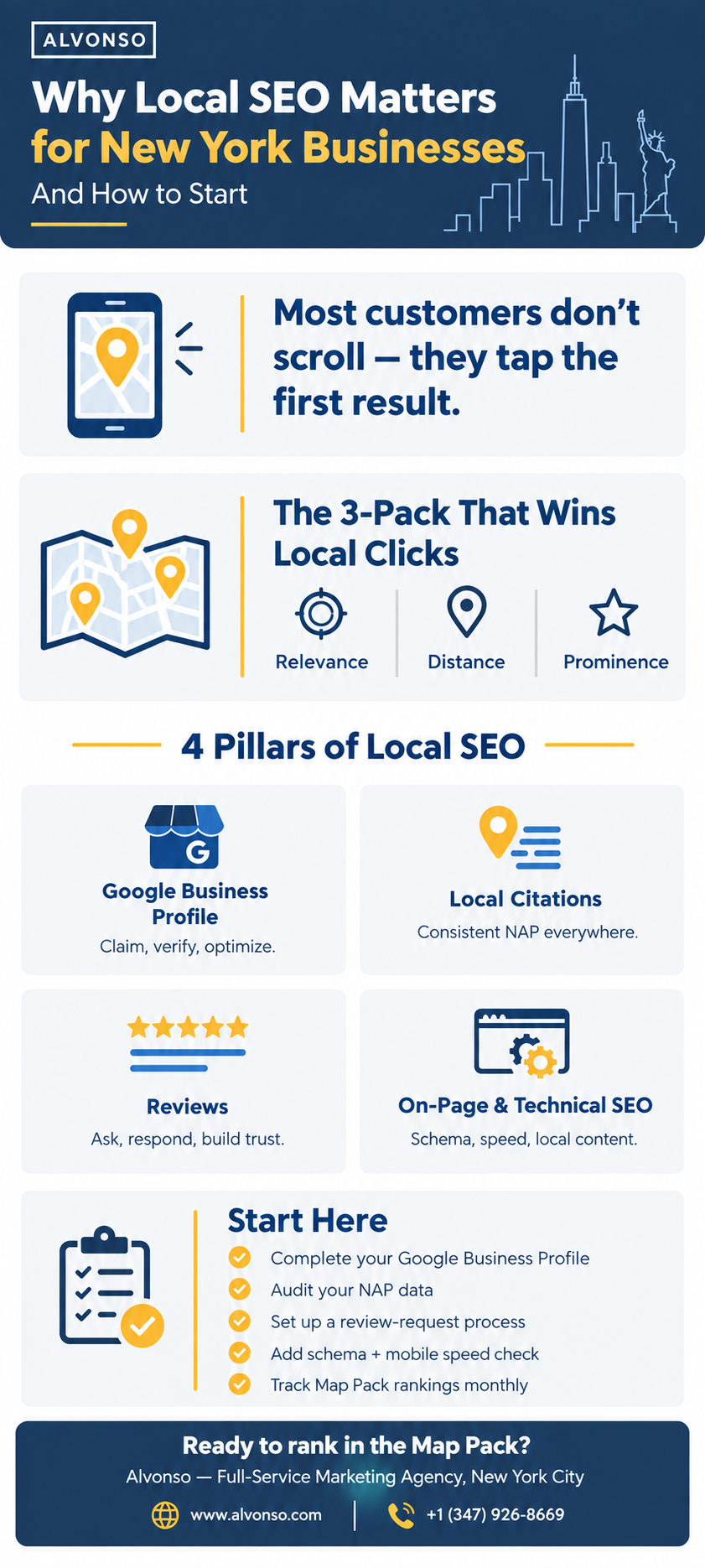
Google explains local rankings around three primary concepts: relevance, distance, and prominence. Relevance refers to how well a business matches the searcher’s query. Distance considers how close the business is to the searcher or the location included in the search. Prominence relates to how well-known or established a business is based on information Google can identify across the web and other sources.
| Local Ranking Factor | What It Means | Examples of Supporting Signals |
|---|---|---|
| Relevance | How closely the business matches the searcher’s intent | GBP category, services, website content, business information |
| Distance | How close the business is to the searcher or specified location | Business location and searcher’s geographic context |
| Prominence | How established and recognized the business appears to be | Reviews, links, mentions, citations, and broader web presence |
Clicking “More places” can take users to Google’s Local Finder, where they can compare a larger set of businesses. This makes local visibility important beyond the first three listings because customers may continue comparing providers before deciding who to contact.
In New York, geographic proximity can be particularly important because multiple businesses may operate within a small physical area. This makes accurate business information, relevance, and prominence especially important parts of a local search strategy.
4 Pillars of a Winning Local SEO Strategy
1. Google Business Profile Optimization
Your Google Business Profile is one of the most important assets in a local SEO campaign. A complete and accurate profile gives Google and potential customers clear information about your business, including what you do, where you operate, when you are open, and how customers can contact you.
- Claim and verify the profile through Google’s official process.
- Keep the business name, address, phone number, website, and hours accurate.
- Choose the most appropriate primary category and relevant secondary categories.
- Add current photographs that accurately represent your business and services.
- Keep holiday and special hours updated when applicable.
- Maintain accurate service and product information.
- Monitor the profile for incorrect user-generated information or questions.
- Use available profile features consistently where they are relevant to your business.
A well-maintained profile supports both customer experience and the broader local search signals surrounding your business.
2. Building Local Citations
A citation is an online mention of your business’s core information, particularly its Name, Address, and Phone number (NAP). Consistency helps customers and search engines identify the same business across multiple sources.
- Keep your business name, address, and phone number consistent.
- Review major business directories and data sources.
- Claim important platforms relevant to your location and industry.
- Build listings on legitimate industry-specific directories.
- Identify and correct duplicate, outdated, or incorrect listings.
Relevant platforms can vary by business type. For example, legal businesses may use legal directories, restaurants may rely on restaurant and reservation platforms, and contractors may benefit from relevant home-service directories.
3. A Proactive Review Strategy
Reviews provide potential customers with social proof and give businesses an opportunity to demonstrate how they interact with customers. A sustainable review strategy should focus on genuine customer experiences rather than artificial review generation.
- Ask genuine customers for feedback consistently.
- Make the review process simple through email, text, or an appropriate link.
- Monitor reviews across Google and relevant industry platforms.
- Respond professionally to positive and negative feedback.
- Never purchase or fabricate reviews.
- Do not pressure customers to leave misleading or scripted reviews.
Customers should be encouraged to describe their genuine experience naturally. This can provide useful context for other potential customers while keeping the review process authentic.
4. On-Page and Technical Local SEO
Your Google Business Profile is only one part of the local search ecosystem. Your website should reinforce the same business information and provide useful, location-relevant content that helps visitors understand your services.
- Create useful location pages when you genuinely serve multiple areas.
- Give each location page unique and useful information instead of duplicated templates.
- Use local keywords naturally in relevant titles, headings, and body copy.
- Implement appropriate structured data where the information is supported by the website.
- Keep the website fast and mobile-friendly.
- Maintain consistent NAP information across the website and important listings.
- Make contact and conversion paths easy to use on mobile devices.
Local SEO Across New York Industries
The core principles of local SEO remain consistent, but the platforms, content, and conversion actions that matter most can vary considerably by industry.
| Industry | Important Local SEO Areas |
|---|---|
| Restaurants & Hospitality | Google Business Profile, reviews, photographs, menus, location information, relevant reservation platforms |
| Law Firms | GBP, legal directories, practice-area pages, location pages, reviews, authoritative content |
| Medical & Dental | Accurate provider information, GBP, relevant healthcare directories, service pages, reviews |
| Home Services | Service-area information, GBP, industry directories, reviews, local service pages |
| Retail & E-commerce | Store information, inventory-related features, GBP, local content, neighborhood links |
The strategy should therefore reflect how customers in that industry actually search and make decisions. A restaurant may need strong visual assets and reservation information, while a law firm may need detailed practice-area and location content. A contractor may need service-area optimization and strong project-related reviews.
Voice Search and the Shift Toward “Near Me” Queries
Local searches increasingly use conversational language, including questions such as “where’s a good coffee shop near me right now?” These searches can contain more context than traditional short keywords and may rely heavily on accurate local business information.
Businesses can prepare by keeping their Google Business Profile information accurate, maintaining current hours and service areas, answering relevant customer questions, and creating clear website content that directly addresses common local queries.
Structured data can also help search engines interpret information on a website, although schema markup should accurately reflect visible and supported business information rather than being used to insert unsupported claims.
Choosing the Right Local SEO Partner
Before hiring a local SEO company, it is useful to understand exactly what the agency will manage, how progress will be measured, and what work is included in the engagement.
- Ongoing management: Ask whether the service includes continuous optimization and reporting or only an initial setup.
- Local results: Ask for documented examples of local search work and explain how rankings and visibility were measured.
- Citation strategy: Ask whether listings are selected based on relevance and quality rather than simply generated in bulk.
- Review compliance: Confirm that review acquisition follows applicable platform rules and does not rely on fake or incentivized reviews.
- Local understanding: Ask how the agency approaches differences between boroughs, neighborhoods, service areas, and customer behavior.
A local SEO audit can provide a useful starting point by showing the current state of your Google Business Profile, website, citations, reviews, local content, and technical foundation.
Common Local SEO Mistakes New York Businesses Make
- Inconsistent NAP information: Different business details across websites and directories can create confusion.
- Ignoring GBP maintenance: A profile should be monitored rather than treated as a one-time setup.
- Failing to respond to reviews: Businesses miss opportunities to communicate directly with customers.
- Overlooking mobile performance: Poor mobile usability can create friction for people searching locally.
- Building citations once and never checking them: Business information can become outdated or duplicated.
- Using generic location pages: Pages should provide genuinely useful information about the locations and services being targeted.
- Expecting instant results: Local SEO generally requires continued optimization, monitoring, and measurement.
Regular audits help identify these problems before they become larger visibility or conversion issues. Businesses can then prioritize the areas that require the most attention instead of making isolated changes without measurement.
How Long Does Local SEO Take to Show Results?
There is no universal local SEO timeline. Results depend on the starting condition of the website and Google Business Profile, competition within the target market, business category, geographic area, website authority, and consistency of the work.
| Local SEO Activity | Potential Early Impact | What Affects the Timeline |
|---|---|---|
| GBP corrections | Can improve the accuracy and usefulness of the profile | Profile condition, competition, relevance, and Google’s processing |
| Citation cleanup | Can resolve inconsistent business information | Number and quality of listings requiring correction |
| Review growth | Can strengthen customer trust over time | Customer volume, industry, review frequency, and authenticity |
| Local content | Can expand relevance for specific services and locations | Content quality, competition, authority, and search demand |
| Technical SEO | Can improve crawlability, usability, and website performance | Severity of existing issues and implementation quality |
Google Business Profile and citation corrections can sometimes produce visible changes relatively quickly, while competitive Map Pack improvements may require months of consistent work. Highly competitive markets and categories can require sustained optimization to maintain visibility.
Measuring Local SEO Success: Metrics That Matter
Local SEO should be measured using more than rankings alone. The most useful reporting combines visibility, engagement, reputation, website performance, and conversions.
- Map Pack visibility: Track how frequently the business appears for relevant local searches and locations.
- GBP actions: Monitor available actions such as calls, website visits, and direction requests.
- Review volume and trend: Monitor the number and direction of genuine customer reviews over time.
- Citation consistency: Audit important listings for accurate business information.
- Local organic traffic: Measure visits from target locations.
- Conversions: Connect local search traffic to calls, forms, bookings, purchases, or other meaningful business actions.
Together, these metrics provide a more complete picture of whether local search visibility is contributing to actual business activity.
How to Start: A Quick Local SEO Checklist
- Claim and fully complete your Google Business Profile.
- Audit NAP information across your website and important directories.
- Create a consistent process for requesting genuine customer reviews.
- Review your website’s mobile speed and usability.
- Implement appropriate local structured data where supported.
- Create useful location pages when you genuinely serve multiple areas.
- Monitor local search visibility and GBP performance regularly.
- Review citations and business information periodically.
- Track calls, forms, bookings, and other local conversions.
Frequently Asked Questions
What is local SEO?
Local SEO is the practice of optimizing your online presence, including your Google Business Profile, website, citations, reviews, and local content, so your business can appear in local and map-based search results for customers searching within a specific area.
How does local SEO work?
Google’s local search system considers factors including relevance, distance, and prominence. Businesses can improve their local search foundation by keeping their Google Business Profile accurate, maintaining consistent business information, publishing useful local content, earning genuine reviews, and developing a trustworthy online presence.
How much does local SEO cost?
Local SEO pricing varies based on the market, competition, number of locations, business category, website condition, and scope of work. Many businesses use local SEO as an ongoing service because visibility requires monitoring and continued optimization. For a customized assessment, contact Alvonso.
How long does local SEO take to show results?
Some Google Business Profile and citation corrections can produce changes within weeks, while competitive local rankings may require several months of consistent optimization. The timeline depends on the business’s starting point, market, category, competition, and implementation quality.
What is NAP in local SEO?
NAP stands for Name, Address, and Phone number. These core business details should remain accurate and consistent across your website, Google Business Profile, and important directory listings.
Why is local SEO important for small businesses?
Local SEO helps small businesses become more visible to people searching for products and services in their geographic market. It can connect businesses with customers who are actively looking for nearby providers and can support calls, visits, bookings, and other local conversions.
What’s the difference between SEO and local SEO?
Traditional SEO generally targets broader organic search visibility, while local SEO focuses on geographic relevance and local search features such as Google Maps, the Map Pack, and location-specific organic results. Local SEO also places greater emphasis on Google Business Profile information, reviews, proximity, and local citations.
How do I improve my local SEO rankings?
Start by making your Google Business Profile complete and accurate, auditing your citations, building a consistent process for genuine customer reviews, improving your website’s technical and mobile performance, creating useful local content, and tracking local visibility and conversions over time.
Why Choose Alvonso Digital Marketing
Local SEO works best when it is connected to the rest of a business’s digital marketing strategy. Website content, search optimization, paid media, social media, branding, and conversion paths can all influence how customers discover and interact with a business online.
Alvonso is a full-service marketing agency headquartered in New York City, providing services that include search engine optimization, content, paid media, social media, web design, and related digital marketing services.
- One coordinated team: SEO, content, design, and paid media can be managed as connected parts of a broader strategy.
- New York market focus: Local campaigns can be developed around the specific geographic markets and customer behaviors being targeted.
- Ongoing optimization: Local profiles, content, citations, and performance can be monitored and adjusted over time.
- Transparent reporting: Reporting can focus on the work completed, visibility, engagement, and business outcomes.
Learn more about Alvonso, explore our digital marketing services, or visit our FAQs for answers to common client questions.
Ready to Improve Your Local Search Visibility in New York?
Local search visibility starts with the fundamentals: an accurate Google Business Profile, consistent business information, genuine reviews, useful local content, and a technically sound website. From there, ongoing optimization helps you monitor changes in your market and identify additional opportunities.
If you want to understand where your business currently stands, visit Alvonso’s contact page to discuss a local SEO audit and a strategy based on your business, location, competition, and goals.
You can also explore Alvonso’s USA services, learn about our UAE services, or visit alvonso.com to explore the full range of digital marketing services.
