Quick Answer
Quick Answer: Effective social media marketing for small businesses in 2026 comes down to three moves: pick one to three platforms where your specific audience actually spends time, post consistently (3 to 5 times a week) using a 60/20/20 mix of educational, brand-building, and promotional content, and reply to comments and DMs daily to build real community trust. Local businesses should lead with Facebook and Google Business Profile, B2B and professional services should lead with LinkedIn, and consumer or visual brands should lead with Instagram and TikTok.
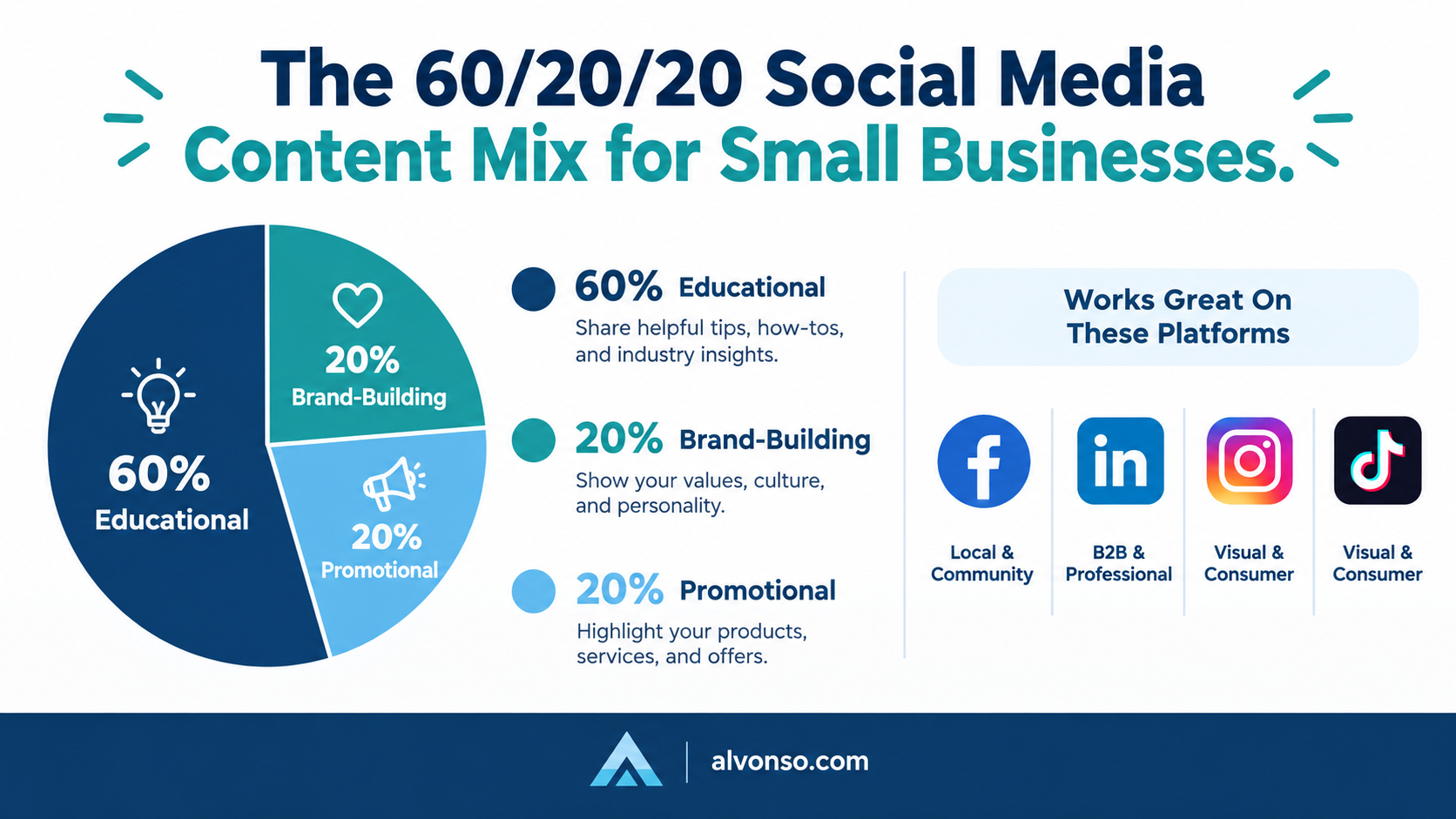
One of the fastest ways to lose followers is posting nothing but promotions. The 60/20/20 framework keeps your feed balanced so people actually want to keep following you, instead of muting your account the moment it starts to feel like an ad channel.
- 60% Educational or helpful: practical tips, how-tos, and answers to questions your customers actually ask. This is the content that gets saved, shared, and found in social search.
- 20% Brand-building or personality: behind-the-scenes clips, team highlights, and relatable, human moments that make your business memorable rather than generic.
- 20% Promotional: direct product or service announcements, offers, and clear calls-to-action — the smallest slice, but still an essential one.
Applied to a five-post week, that typically looks like three educational posts, one brand or behind-the-scenes post, and one promotional post. The mix does not need to be exact every single week — it just needs to stay roughly in that range over a month so your audience does not feel constantly sold to.
Sample Weekly Content Calendar
Here is a simple five-day template that applies the 60/20/20 mix in practice. Treat it as a starting structure, not a rigid rule — swap days and formats to fit your industry and posting cadence.
| Day | Content Type | Example |
|---|---|---|
| Monday | Educational (60%) | A quick tip or how-to related to your product or service |
| Tuesday | Educational (60%) | Answer a common customer question in a short video or carousel |
| Wednesday | Brand-building (20%) | Behind-the-scenes look at your team or process |
| Thursday | Educational (60%) | A myth-busting or industry-insight post |
| Friday | Promotional (20%) | A weekly offer, new product, or clear call-to-action |
Notice that only one of the five days is directly promotional — the rest earns attention first. That ratio is what keeps an audience engaged instead of tuning out.
Content Calendar Basics: How to Plan a Month of Posts
A content calendar is what separates a business that posts randomly, in bursts, from one that shows up consistently. It does not need to be complicated — a simple spreadsheet or planning tool is enough to start.
- Block out your posting days first (for example, Monday, Wednesday, Friday) before you decide what to post on each one.
- Batch-plan a full month at once using the 60/20/20 mix, then adjust individual posts as real-time events or trends come up.
- Group content by theme per week (a tips week, a customer-spotlight week, a behind-the-scenes week) so ideas are easier to generate in batches.
- Leave 20% of your calendar unplanned for timely, reactive posts — trending audio, a customer question worth answering publicly, or a real-time company update.
- Review what performed best each month and roll those formats forward — a content calendar should evolve based on real data, not stay static.
2026 Tactics That Actually Move the Needle
A few shifts define what separates an effective small-business social strategy in 2026 from one that is simply keeping up appearances.
Use AI for Planning, Not for Your Brand Voice
AI tools are genuinely useful for brainstorming a month of content ideas, drafting first-pass responses to frequently asked questions, and analyzing patterns in customer reviews. They are far less useful as a replacement for your actual brand voice — audiences can usually tell when a caption was generated rather than written by someone who knows the business.
Treat Social Captions Like Search Content
Because consumers increasingly search directly within social platforms, your captions and profile bio should include the actual words your customers search for — not just clever wordplay. A bakery captioning a photo “best gluten-free cupcakes in [city]” will get found by more of the right people than one captioned only with an emoji string.
Prioritize Engagement Over Posting Volume
Consistency is about more than hitting a posting schedule. Platforms reward accounts that respond quickly to comments and direct messages, because that activity signals a genuinely active community. Setting aside even fifteen minutes a day to reply to comments and DMs often moves the needle more than an extra weekly post would.
Tools That Help Small Businesses Stay Consistent
A handful of tools cover most of what a small business needs to run a consistent social presence without a large team behind it.
- Scheduling tools (like Meta Business Suite, Later, or Buffer) let you batch-plan a week or month of posts in one sitting instead of posting live every day.
- Simple design tools (like Canva) make it possible to produce on-brand graphics and short video edits without a dedicated designer.
- A shared spreadsheet or lightweight project board is usually enough to track your content calendar, caption ideas, and performance notes in one place.
- Native platform analytics (Instagram Insights, Facebook Page Insights, LinkedIn Analytics) are typically sufficient for a small business to spot which content formats are working before investing in a paid analytics tool.
None of these tools replace a strategy — they just make it easier to execute one consistently, which is where most small businesses actually struggle. A well-chosen scheduling tool, for example, turns “I need to post something today” into “this week is already planned,” which alone removes most of the friction that causes accounts to go quiet for weeks at a time.
How Alvonso’s SMM Service Works
If managing all of this in-house is more than your team has time for, this is exactly what a dedicated social media marketing service from Alvonso is built to handle. Every engagement starts with a free audit and a no-pressure conversation about your goals, so the strategy is built around your business rather than a generic template.
- Platform strategy: Alvonso identifies the one to three platforms where your specific audience is most active, rather than spreading effort across every network.
- Content planning and creation: a content calendar is built around your brand voice, following a balanced content mix so your feed never feels like a nonstop sales pitch.
- Community management: comments, messages, and follower interactions are actively managed to build a real connection with your audience, not just post-and-forget.
- Paid social integration: where it makes sense, organic content is paired with targeted paid campaigns to extend reach beyond your existing followers.
- Reporting in plain language: performance is tracked and reported back clearly, so you always know what is working and why, without needing to interpret a dashboard yourself.
Because Alvonso combines global marketing expertise with local, on-the-ground insight across both the USA and the UAE, the same core process adapts to different regional audiences and platform habits rather than applying a one-size-fits-all playbook.
Results You Can Expect From Professional Social Media Management
Results from social media marketing typically show up on two different timelines. Community growth — followers, engagement rate, comment activity — tends to build steadily within the first one to three months as posting consistency and content quality improve. Business-level results — leads, bookings, and sales attributed to social — usually become clearer over three to six months, once the account has a consistent posting history and enough content to test what resonates.
- Higher engagement rate as content shifts from purely promotional to a balanced, genuinely useful mix.
- Faster response times to comments and DMs, which directly affects how many inquiries convert into actual customers.
- A growing library of high-performing content formats you can keep repeating, instead of guessing what to post each week.
- Clear, plain-language reporting on what is actually driving traffic, leads, or sales back to your website — not just vanity metrics like likes and impressions.
It is worth setting expectations honestly from the start: social media rarely produces overnight virality, and any provider who promises guaranteed follower counts or guaranteed sales within weeks is setting up an unrealistic benchmark. What a well-managed account should deliver instead is a steady, measurable trendline — more engaged followers each month, a growing set of content that reliably performs, and a clearer picture over time of exactly which posts turn into real inquiries and sales.
If you want a clearer sense of what this could look like for your specific business, reach out for a free marketing audit — it is a straightforward way to see where your current social presence stands before committing to anything.
Common Mistakes Small Businesses Make on Social Media
Most underperforming social accounts are not failing because of the platform — they are repeating one or two of the same avoidable mistakes month after month.
- Trying to maintain five platforms with the bandwidth for one — spreading content thin usually performs worse than fewer, more consistent posts.
- Posting only promotional content, which causes followers to mute or unfollow within weeks.
- Ignoring comments and direct messages, which signals an inactive, untrustworthy account to both customers and the platform’s algorithm.
- Copying a competitor’s content style without adapting it to your own brand voice and actual audience.
- Treating social media as a one-time project instead of an ongoing, evolving process that needs regular review.
Most of these mistakes trace back to the same root cause: treating social media as an afterthought squeezed into spare time, rather than a planned, recurring part of the business. A basic calendar and a consistent posting rhythm solve the majority of them on their own.
Frequently Asked Questions
How often should a small business post on social media?
Three to five times per week on your primary platform is a solid baseline for most small businesses — enough to stay visible and build consistency without burning out your team. Quality and a balanced content mix matter more than sheer posting volume.
Which social media platform is best for a small business?
It depends on your business type and audience. Local and community businesses tend to see the strongest results on Facebook and Google Business Profile, B2B and professional services perform best on LinkedIn, and consumer or visual brands see the most organic reach on Instagram and TikTok. Choose one to three platforms where your specific audience already spends time rather than trying to cover every network.
What is the 60/20/20 rule in social media marketing?
It is a content-mix framework: 60% educational or helpful content, 20% brand-building or personality content, and 20% direct promotional content. It keeps a feed balanced so followers do not feel like they are being pitched to constantly, which is one of the fastest ways small businesses lose followers.
How much do social media marketing services cost for a small business?
Pricing varies based on the number of platforms managed, whether paid advertising is included, and the level of content production involved. A transparent smm services provider should give you an itemized breakdown of management fees versus ad spend, rather than a single bundled number, so you know exactly what you are paying for.
How long does it take to see results from social media marketing?
Engagement and follower growth typically build within the first one to three months of consistent posting. Business-level results — leads, bookings, and sales attributed to social — usually become clearer over three to six months, once there is enough consistent content and posting history to identify what is actually working.
Should a small business handle social media in-house or hire an agency?
It depends on available time and expertise. In-house management works well when someone on the team can consistently dedicate real hours to content, strategy, and community management every week. When that time is not realistically available, a dedicated smm services provider can maintain the consistency and strategic planning that sporadic in-house posting usually struggles to sustain.
Do I need to be on every social media platform to grow my small business?
No — and trying to often backfires. A small business with limited time is usually better off posting consistently on one to three platforms where its specific audience is active than spreading thin, inconsistent effort across five or more networks. It is easier for both your team and the algorithm to build momentum on a focused presence.
Final Thoughts
Effective social media marketing for small businesses in 2026 is less about being everywhere and more about being consistent, useful, and genuinely responsive on the one to three platforms where your actual audience spends time. A balanced content mix, a simple content calendar, and daily engagement will outperform a scattered, promotion-heavy presence across five networks every time.
If building and managing that consistency is more than your team can take on right now, connect with Alvonso for a free audit of your current social presence, or explore more strategy breakdowns on the Alvonso blog.
